Hospital safety is at a crossroads. The threats facing healthcare facilities today go far beyond clinical errors—they include active shooter scenarios, workplace violence, and communication breakdowns that can cost lives.
In high-stress moments, every second counts, yet many hospitals still rely on manual processes that slow response times and leave staff vulnerable. The good news? Technology is rewriting the playbook for emergency communication and staff protection. From automation and integration to real-time location systems (RTLS), hospitals now have tools that make safety faster, smarter, and more reliable than ever before.
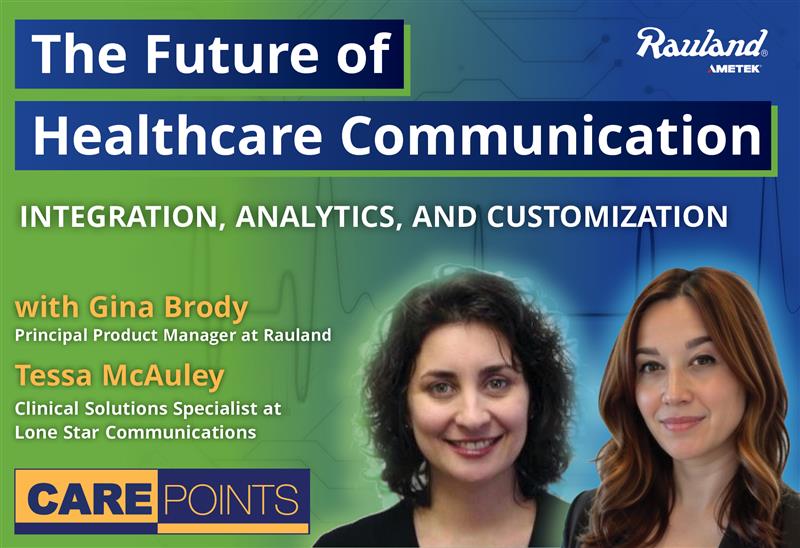
At the helm of this conversation is Gina Brody, Principal Product Manager at Rauland and Tessa McAuley, Clinical Solutions Specialist at Lone Star Communications at Lone Star Communications. Their perspectives bridge product strategy and frontline practice. Gina brings a decade of experience building healthcare software and open, integrated workflows, while Tessa complements that with hands-on clinical solutions work, translating those capabilities into intuitive steps that shorten Code Blue response and strengthen staff confidence. Together, they connect the why of safety with the how of implementation—making complex technology feel practical, actionable, and ready for the floor.

The Breakdown
- The New Reality of Hospital Safety: Hospitals face rising risks—from workplace violence to delayed Code Blue responses—making rapid, reliable communication a critical patient and staff safety issue.
- Breaking Down Communication Barriers: Automation and integration eliminate manual steps and misroutes, unifying nurse call, overhead paging, duress alerts, and handhelds into a single, orchestrated response.
- Technology That Makes Safety Simple: RTLS badges, wearable duress, and configurable workflows deliver “right info, right person, right time” clarity—so clinicians can act fast with fewer taps and less cognitive load.
- Data-Driven Improvements: End‑to‑end analytics reveal exactly what happened (who arrived when, what escalated, where delays occurred), turning every event into actionable insights for continuous improvement.
- Practical Steps: Start with existing infrastructure, pilot targeted automations, and iterate with stakeholders—scaling what works to build safer, smarter hospitals without rip‑and‑replace.
Direct Answer:
Hospitals are facing new safety challenges that demand faster, smarter communication. Automation, integration, and RTLS technology are transforming emergency response—eliminating manual delays, improving staff protection, and delivering the right information to the right person at the right time. With actionable strategies for leveraging existing infrastructure and using analytics for continuous improvement, healthcare leaders can build safer, more efficient workflows without costly overhauls.

Bridging Communication and Action: From Integration to Simplicity
When seconds count, fragmented tools slow down teams. “You could call an ambulance 911 outside this hospital and get a better response time than inside of it. That’s what we’re working to change,” said McAuley. The path forward is orchestrating communication, unifying nurse call, overhead paging, duress alerts, and handhelds, so the right people are notified instantly with clear roles and locations.
To underscore the design principle behind this: “Both Responder and Telecenter are built with an open architecture… [so] all the other pieces… that involve safety for your staff can work together,” said Brody. Integration turns a maze of manual steps into a single, reliable playbook.
In a crisis, cognitive load skyrockets. The workflow must be simple enough to execute on autopilot. Voice isn’t always dependable amid noise and commotion, so systems must privilege clear, tactile actions that trigger automated routing and escalation. “What do I need to know when I’m walking down the hall? … Before I take a step into that room, what information do I need to know?” said Brody. Designing clarity—lights, boards, pages, and mobile alerts—keeps teams aligned and accelerated the first, most critical interventions.
Integration and simplicity deliver speed; analytics and RTLS deliver accountability and learning.
With RTLS badges, staff presence is verified, calls auto-cancel when a clinician enters, and duress can be signaled hands-free, “When I have my hands full of patient… I can hit the button on my badge… [and] immediately go to my team,” said Brody. These data points reveal bottlenecks (equipment distance, team location, escalation timing) and power iterative improvements—turning each event into a blueprint for faster, safer responses next time.

Ready to Turn Minutes into Seconds?
Safety gains don’t come from buzzwords—they come from orchestrated communication, intuitive workflows, and data you can act on. If your team is still juggling manual steps during emergencies, now’s the moment to streamline with automation, RTLS, and integrated alerts that put the right information in the right hands fast.
Gina Brody is the Principal Product Manager at Rauland, where she has spent the past decade shaping innovative healthcare communication solutions. With extensive experience in healthcare software, Gina is a recognized expert and thought leader in patient and staff safety technologies. Her work focuses on integrating systems, customizing workflows, and driving product strategies that improve outcomes in acute care environments.
Tessa McAuley is a Clinical Solutions Specialist at Lone Star Communications, bringing deep technical expertise in Rauland’s Responder systems. A former Rauland employee, Tessa now works as part of Lone Star’s 17-member clinical team, supporting implementations and service for healthcare facilities nationwide. She collaborates closely with hospitals to optimize workflows, enhance emergency response, and leverage technology for safer, more efficient care delivery.
©1991-2025 Lone Star Communications, Inc. and/or its affiliates.